Richly imagined, in its own little constrained world, the surrogate dopplegangers of Stanley Leiber and Jacob Katzenburg reach the end of their lifes and try to reconcile or try to avoid reconciliation when little is left of the world that they had started. How does it end? Badly, as you would expect, and messy, in all the ways that you would also expect.
Finally had the chance to sit down and really read through Citizen Conn by Michael Chabon from the February 6 & 13 issue of the New Yorker and it was an interesting read, but ultimately and puzzling one. I'm not surprised by Chabon working comic book territory again, after all, he loves the stuff down to his DNA as much as I do, as much as i expect the readers of my blog to, and so, instead of being upset with him mining comic book iconography and mythology (as I am with Lichtenstein), I appreciate his take on our favorite guilty pleasure medium. He can write, really write, and its a joy to read his sentences as opposed to so many other writers.
So for him to turn to the ugly soap opera ridden uncertainty that is the Stan Lee/Jack Kirby is certainly interesting, and certainly his take on the story is the right one: rather than assigning who did what in the never-to-be-visited past (there is nothing more subject to the Roshamon effect than the origins of the Marvel Comics Group), he visits the later days of these creative giants. Days when the pages no longer fly off the board and the typewriter is still and the effects of money, time, lawyers and long ago signed backs of Work For Hire checks have long since had their way.
But, tellingly, the Kirby of the story has no Roz to take care of him. He is a prototypical loner, who toiled at his drawing board for too many years and never had the support of a wife or children, and so it is the Kirby surrogate, Morton Feather, moving into an assisted living facility while struggling with bone cancer, who has no dilution of focus. The Stan Lee of the story, Artie Conn, may be married, but we see none of that, we only see his attempts to reconnect with Feather so many years after the Fantastic Four, Thor, The Hulk, and, of course, The Avengers.
It focuses the anger that Feather feels towards Conn that neither has a spouse who walks on stage during the story to take the focus. The female rabbi who narrates wisely has a husband who stands in for us, the average fan, and we get the chance to see how ineffectual our love and devotion to those long yellow paged stories is. It puts us in our place almost instantly and takes us out of the narrative to the benefit of the story.
No, the focus, the rabbi would have us believe, is in the betrayal that was felt in the late '60's when promises were reneged on and Lee signed up to a life of solid wealth and Feather... oh, hell with it, Kirby forced to move to DC and a life of decaying freelance assignments and meager checks. After all, the rabbi's husband, and, by proxy, us, have our joy in opening those books and discovering those stories and becoming enmeshed in the world as Lee and Kirby unfolded, month after month, but, lets face it. We're nothing compared to the men who took the time to create and live in those universes first. While we merely rented an apartment there, no matter how vested we THINK we, they built the whole damn subdivision from an empty lot. Chabon's case, as i see it, is that the money and the lawyering and Stan's taking credit was secondary to the betrayal of the partnership with which those two created.
Those of us with interest in those sorts of things have read plenty of contradictory interviews regarding who did what. And its clear that it will never be settled because, for too many years, their working method was too streamlined, too overlapping, too damn quick given the deadlines to not just keep filling the pages and stay on a roll. Like your favorite band, there is no way to know who came up with that one riff that played perfectly off of the rhythm; both the bassist and guitarist will remember it as something that they came up with, when, in reality, there was a synergy that allowed the creativity to spin off into far more interesting directions even through disagreement.
And that's something that gets brought up all too often in the painful details of Stan and Jack's splintering. That there would have been a number years when the business started taking off again and the books got better and Stan and Jack were creating so much that the pages and the issues just flew by. And while it was exhausting it was probably also exhilarating with both men doing what they loved to do and seeing it all start to come together. They were in their moment and that moment would be about 6 brilliant years of sleepless nights and feverish working days and ink stained hands.
Chabon sums it up in the penultimate paragraph, when Lee's doppleganger gets to exclaim, "You know what? that wouldn't surprise me a bit. he always took everything so seriously." in reference to the idea that the partnership was the defining moment for Kirby, while Lee, more easy going in temperment, simply moved on. Kirby's desire to create was likened to a force of nature within him, so of course he'd take it all so damn seriously. And when you add in the money, oh all that money we know about, then it changes things. The story's solution is a simple solution, and one that we know works well in comic book logic: sadly, real life is so often messier and far more complicated.

Showing posts with label stan lee. Show all posts
Showing posts with label stan lee. Show all posts
Thursday, May 03, 2012


Wednesday, May 21, 2008
Stan Lee, Steve Ditko, and the Spider-Man Originals Redux
Having read both the comments on my original post, along with the others were listed below heidi macdonald's link to my post, i stand convinced that Stan would not have been to donor of the amazing Fantasy #15 artwork. Having unfairly implicated him, I publicly retract some of my original comments/accusations.
This leads me to something that I've thought about posting for a long time, but simply haven't made the time to do: talk about the infamous warehouse that Marvel stored their artwork in. Its more than urban myth, but some of the story is worth bringing out. Watch for the fallout on this one.
And, for the record, just like with the Lee/Ditko piece, i'd rather get something wrong but get the discussion going so that the truth can either come out (or at least dispel rumors) along the way.
This leads me to something that I've thought about posting for a long time, but simply haven't made the time to do: talk about the infamous warehouse that Marvel stored their artwork in. Its more than urban myth, but some of the story is worth bringing out. Watch for the fallout on this one.
And, for the record, just like with the Lee/Ditko piece, i'd rather get something wrong but get the discussion going so that the truth can either come out (or at least dispel rumors) along the way.
Sunday, May 18, 2008
Stan Lee, Steve Ditko, and the Spider-Man Originals
 I am sure that most of us had the chance to see this little tidbit of information from the Library of Congree blog:
“Spider-senses” all around the Library were set tingling when we learned that the Library had just acquired 24 pages of original 1962 drawings from “Amazing Fantasy #15,” which marked the first time the world’s most famous web-slinger, Spider-Man, would appear in print anywhere. The Spider-Man origin story in “Amazing Fantasy” was created by Stan Lee and Steve Ditko; the pages are Ditko originals, complete with pencil erasures and white-out opaquing fluid.and this bit on the actual donation and number of pages:
While I'm missing the attribution, it has been said that the donor asked Steve Ditko's blessing before making the donation, so the question is, who is the donor? Or should we say, who isn't the donor? And I certainly, with no other information other than real, true fanboy supposition, have to say: is there anyone in the world other than Stan Lee that could be the donor?
Lets use a little logic here. Artwork from that era is rare, and having an entire story together speaks volumes over who might have had their hands on the originals. Fantastic Four pages from a similar time frame have hardly shown up even after Jack's death, and when they do, they are split up and scattered across the world.
Who do we know that was around the office back then? Stan, Jack, Steve Ditko, Flo Steinberg in the office, Sol Brodsky in production, letterers like Artie Simek who would have worked in the bullpen. From the interviews, its hard to see Martin Goodman or any of the other Goodman family like his son Chip being there to get their hands on it. Most of these folks are dead, so we have to cross them off the list.
Who would have the motive to donate artwork like that, artwork that is worth a huge amount, potentially millions of dollars? We would have to posit that it was someone who was financially well off, someone who didn't need the money. In all that we know, Stan is well set up in a way that Jack and Steve never were and never would be. He was the company man for years and years, and has his name on all these properties, and I doubt that that has come cheap in his contracts. Plus, we know that he had a contract to get a piece of the films. Yes, the films.
What would be the motive about the donation? What would Stan have to gain by this? In his case, reputation. While Jack and Steve were marginalized over the years by Stan the Man while Stan was still at the helm, even ceremonially, of Marvel, time has done some interesting things to this particular legacy. Jack Kirby has literally been taken from obscurity at the end of his career and HERBIE the robot to being revered as a pop culture icon by multiple books and magazines. Stan, essentially, has been marginalized by those who have taken up Jack's torch and been carrying it since his debacle with the Marvel artwork return. Spider-Man is the one main bit of the Marvel pantheon that isn't Stan and Jack. Fantastic Four, Hulk, Thor, Iron Man, the X-Men, the Silver Surfer and all the rest - we could see them as proof of Jack's creative legacy.
Don't talk to me about Doctor Strange. This is Spider-Man. And this is Stan and Steve. This is Stan confirming his legacy outside of Jack Kirby. And with the Library of Congress donation there is both a certain level of legitimacy and immorality granted.
There really isn't any one else that could have had the chance to get their hands on the complete book. So why doesn't Stan come forward and simply admit that he wanted to donate the original issue for national posterity? Perhaps for the same reason that he wouldn't want to admit that he has some of the other artwork from the beginnings of the Marvel universe. When the pencillers and inkers signed the backs of their checks, they forfeited their rights to the work. But I doubt that Stan ever had to sign such a check. How much of a legal grey area is that artwork in? How much claim to that artwork could the former and current corporate owners have?
Until I hear differently, or other information comes to light, I'll be happy to assume that Stan is the one that made the donation. And while I'm not really sure that it changes my idea about him or his legacy, all I can say is this: as an artist, and a comic book fan, I've very glad that the artwork still exists and in good form. While I doubt that I'll ever get the chance to see it personally, I love knowing that those pages are out there, or at least in there.
Edit 5/21/08: If you direct linked here, then click here for the follow up post.
Tuesday, March 18, 2008
In Review Of - Kirby: King of Comics by Mark Evanier
 I'm so happy to see Jack Kirby finally being enshrined as the true pop culture icon that he deserves to be, that I feel rather ungrateful to be critical of Mark Evanier's book, Kirby: King of Comics.
After all, first things first, this is a beautiful, clean volume that gives us excellent reproduction, nay, gorgeous reproduction from original art that we are likely never to see in person (the original full page of Thor from the first issue of Journey into Mystery is simply magnificent, and the head shot of Galactus that is, I believe, from an issue of Thor, is so well produced that we can actually see the variation in india ink on Galactus' face). With clean layouts, and high quality paper, we get the moire pattern from the four color dots with a clarity that we've never had before. The power with which Jack composed his panels shines through with unmatched clarity.
The part that bothers me is the writing. There is simply too little of it. This is a coffee table book sits directly in the middle of the two things that it needs to be: it should either be a Little Nemo size to reproduce the twice-up art properly (and I can imagine a 120 page book, simply of full size reproductions of Kirby originals, selling rather well), or it needs to be similar to Milt Caniff phone book and say hell with the artwork, lets really tell the man's story. And it is neither.
There are countless stories about Jack out there, and he was around so long, that he deserves a book written with the level of detail and critical assessment that Meanwhile... as written with. After all, Caniff's heyday was honestly no more than about 10 or 12 years long, and Jack hadn't even hit his best period that far into his career. For as much as Evanier complained that the Tales to Astonish biography released two years ago was riddled with inaccuracies, that book even contains stories that didn't make it into this one.
Simply put, Jack deserves a real biography, and likely Evanier is the one person that could actually write it. The question is whether he will ever get around to it. In my opinion, the very best parts of this book are where Mark veers off of the beaten path, reciting the same facts surrounding the myriad problems with Marvel's returning his artwork, and moving on to the more interesting behind the scenes of actually working with Jack at his house, or working at the ill-fated Marvelmania offices. I'm sure that Mark wanted to get this one volume out there, to supplant the production challenged Art of Jack Kirby that Kevin Eastman put money behind a decade ago, or the aforementioned Tales to Astonish as the go-to volume for those just their feet wet on one of the most inventive brains of 20th Century Pop Culture, but now we need the real book.
We need the one with all the meat behind it, the one that compiles all the detective work from the Jack Kirby Collector comparing Jack's liner notes to the ones that Stan actually dialogued, the one that hunts down those damn interns who actually went to the warehouse in '68 to see what artwork still survived after the flood, the one that marries Captain America and Adolph Hitler and the the Iger studios and Mort Meskin into one beautifully comprehensive package.
I worked my way through the Caniff volume more because I loved hearing about the working conditions of the artists of that time, loved reading about the business and the models and the chalk talks more so than Milt Caniff. I was never that big a Terry fan honestly.
And I still worked my way through a 1000 pages of Caniff biography.
Perhaps we will get the same for Jacob from the lower east side. He deserves it, and it is a fascinating story from just about every angle. And in the meantime, go buy Mark's book. It may not be the all-encompassing volume that I had hoped for, but that is more my fault that it is his, and this is still a beautiful book. And if we want more of this, more books that cater to us, then we need to support them. So yes, go buy the thing from a local bookseller!
Thursday, June 21, 2007
Fantastic Four: Review of the Silver Surfer
OK, I fully admit this is pretty damn hard to write a review of. We get the inevitable "Kirby whirlwind" in this movie . Seriously. A whirlwind. When was the last time that you saw one of those since "Twister" came out?
 For years we've been decrying Hollywood messing up perfectly good comic stories by having to change and add and tweak the source material, material that clearly worked perfectly well on the printed page. "Why would you mess with the Galactus Trilogy?" we ask.
And we have our answer here. And its not an easy one to assess. We have a movie that is closer to the source material that any movie has come to, barring only X-Men 2. I was actually thrown by the early scenes in New York, with the FF in the Baxter Building, because the tone was so different from the first movie, and then I realized: I was actually seeing a Lee/Kirby comic, somewhere around FF #25 or so, brought to life. Ben and Johnny fighting, Reed and Sue having their small spats, using their powers casually amidst the banter. And it makes sense that they would, when you consider that we shouldn't have to see all the drama of Johnny flaming on, and Ben using his strength, the powers simply become an extension of what the characters do and who they are.
So, does all the Lee/Kirby banter and play translate to the big screen? Not entirely, although it seems to be a noble attempt. Someone really went back and read their Marvel essentials to try and get this right, and they almost did. I have to say, I love Alicia as a black woman, and think that it would be really cool to see her father, an African-American Puppet Master at some point.
When you consider that the first FF movie was one of the very worst superhero movies that has ever come to screen, stunned was a damn good description of just how different this script is. And I can't help but think if we had spent more time with this version of the characters, as opposed to the morose "grim and gritty" versions from the first movie, that we would care more and feel more feeling for when everything goes wrong in the second act.
And what a second act it is, really. A great combination of FF #49 and #60 which should be one hell of a winning storyline when you think about it. Doom, the Surfer and a weird cloud thing called Galactus (don't get me started on this one yet). And yet... despite a great helicopter crash sequence, the tension never really rises as much as it should, and the return of Doom falls far flatter than it should with Julian McMahon's missing the mark performance. But the whole thing simply never jells. I suppose I keep thinking that this would have been a great season finale, when we'd had time to share all the earlier adventures with them.
Alas we don't have that time. We do get treated to a Surfer that looks a whole lot like Kirby's version, and we even get a whole mess o' Kirby action, although forgive me if, for some reason, I thought that the action also seem choreographed somewhat by George Perez. I wish that we had more Ben Grimm in it to tell you the truth. Perhaps the next movie will be The Thing vs. The Hulk two parter.
And, at the last, Galactus as a huge cloud. Perhaps I'm alone in this, and believe me, I inwardly cringed more than most when I read about this one on the internet, but I have to say that I'm not sure if the comic book Galactus would have worked. Really. I'm not saying that the illegitimate son of V'Ger is really working for me, but it is better than some of what they would have come up with.
I don't think that this is a great movie by any stretch of the cinematic imagination, and yet, it is so damn superior to the first that it shines far more brightly than I think it should. Props to all for trying.
 For years we've been decrying Hollywood messing up perfectly good comic stories by having to change and add and tweak the source material, material that clearly worked perfectly well on the printed page. "Why would you mess with the Galactus Trilogy?" we ask.
And we have our answer here. And its not an easy one to assess. We have a movie that is closer to the source material that any movie has come to, barring only X-Men 2. I was actually thrown by the early scenes in New York, with the FF in the Baxter Building, because the tone was so different from the first movie, and then I realized: I was actually seeing a Lee/Kirby comic, somewhere around FF #25 or so, brought to life. Ben and Johnny fighting, Reed and Sue having their small spats, using their powers casually amidst the banter. And it makes sense that they would, when you consider that we shouldn't have to see all the drama of Johnny flaming on, and Ben using his strength, the powers simply become an extension of what the characters do and who they are.
So, does all the Lee/Kirby banter and play translate to the big screen? Not entirely, although it seems to be a noble attempt. Someone really went back and read their Marvel essentials to try and get this right, and they almost did. I have to say, I love Alicia as a black woman, and think that it would be really cool to see her father, an African-American Puppet Master at some point.
When you consider that the first FF movie was one of the very worst superhero movies that has ever come to screen, stunned was a damn good description of just how different this script is. And I can't help but think if we had spent more time with this version of the characters, as opposed to the morose "grim and gritty" versions from the first movie, that we would care more and feel more feeling for when everything goes wrong in the second act.
And what a second act it is, really. A great combination of FF #49 and #60 which should be one hell of a winning storyline when you think about it. Doom, the Surfer and a weird cloud thing called Galactus (don't get me started on this one yet). And yet... despite a great helicopter crash sequence, the tension never really rises as much as it should, and the return of Doom falls far flatter than it should with Julian McMahon's missing the mark performance. But the whole thing simply never jells. I suppose I keep thinking that this would have been a great season finale, when we'd had time to share all the earlier adventures with them.
Alas we don't have that time. We do get treated to a Surfer that looks a whole lot like Kirby's version, and we even get a whole mess o' Kirby action, although forgive me if, for some reason, I thought that the action also seem choreographed somewhat by George Perez. I wish that we had more Ben Grimm in it to tell you the truth. Perhaps the next movie will be The Thing vs. The Hulk two parter.
And, at the last, Galactus as a huge cloud. Perhaps I'm alone in this, and believe me, I inwardly cringed more than most when I read about this one on the internet, but I have to say that I'm not sure if the comic book Galactus would have worked. Really. I'm not saying that the illegitimate son of V'Ger is really working for me, but it is better than some of what they would have come up with.
I don't think that this is a great movie by any stretch of the cinematic imagination, and yet, it is so damn superior to the first that it shines far more brightly than I think it should. Props to all for trying.
Wednesday, February 07, 2007
Fantastic Four #102: Lost and Found

Over on the TwoMorrows blog is a great post about the recreation of FF#102, which was Kirby's last issue on the title. Rejected, the artwork was cut up and used, in part to create FF #1o8. Well, it looks like we'll finally get the chance to see it in this form:
Enter Tom Brevoort, who got the inspired idea to have Stan finally dialogue Jack’s pencils, and Joe Sinnott ink them (I’ve seen the new inks, and man, Joe hasn’t skipped a beat in the 37 years since he was inking Jack on the FF). Tom’s also getting a current Marvel writer and inker to do their interpretations, and both finished versions (plus Kirby’s uninked original, and a short article about it by your’s truly) will appear in the one-shot special.This great news, just the finally get the director's cut of the issue the way that it should have been done. Kinda like getting to sit down and read those old Strange Tales with the Torch and the Thing, and its discovering a whole parallel universe to the regular FF book. Finally Kirby's bow out on the book he helped to create will see the print the way that it should have been done back before his jump to DC.
TwoMorrows while I don't always agree with their editorial position on everything, generally does a great job with their publications, very classy, and I am quite happy to own more than a few issues on the shelves of my studio.
Saturday, November 25, 2006
The Great Jack Kirby Mystery
 Somewhere back in the dawn of time when I started this blog I was deliriously ecstatic by finally being able to get a 2x up Kirby FF page to add to the my collection. I still am ecstatic about it, and have not had the thing put into the frame as I like to pull it out and look at it up close. There is something very visceral about large art of that sort. It takes over the drawing board and is very physical to handle. Inking something that large involves your entire fore arm, not just a wrist. I like to imagine jack working vigoriously away on these pages at night.
But there is something interesting about the piece that has been bugging me. and I thought that I'd put it out to the assembled internet-land:
the liner notes on the page are wrong.
Below is the piece that I picked up: FF #20, page 14.
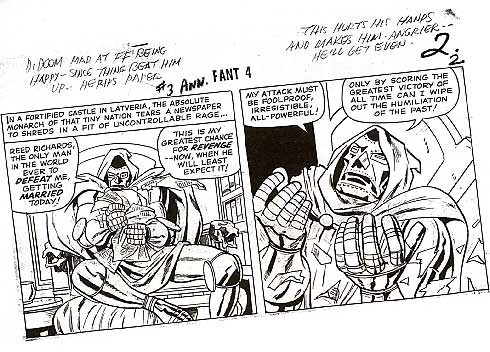
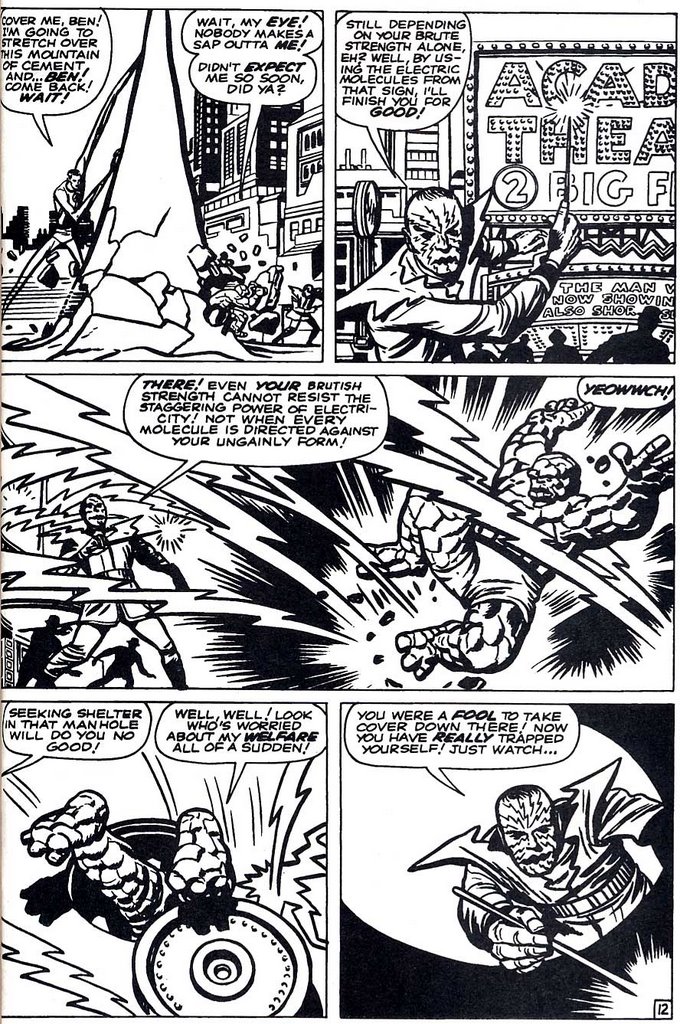 Scanned off of the essential FF book as it's too damn big for my scanner. Now, thanks to the Jack Kirby collector, we've been fortunate enough to see pages and pages of stats of Jack's pencils, and we've been able to see many of Jack's liner notes that he did for Stan. Even more, much of the artwork that exists out in collectorville and dealerland all have the notes still on them. jack typically wrote in a strong, all caps style, examples of which you can see in the first illustation at the top of this post, and below this paragraph:
page 14, on the other had only has two liner notes, both in a tight scribble. Both are scanned here. The first is from just below jack's sig:

and the second to the left of panel 3:
 So the question remains: why is the handwriting so different? Why no liner notes on the rest of the page? Any guesses anyone?
I'd love, if anyone has any further information about where this page has been before ending up in my hands, to know about it as well.
Edited to note: I fired off this info to Mark Evanier to ask his opinion and here is what he said:
I'll follow this up with any more data that I can find on Lee's handwriting or Sol Brodsky's.
I don't know who did that Jack Kirby signature but it wasn't Jack Kirby.
The other handwriting you noted on the margins of the F.F. page looks
like Stan's to me but I'd have to see it in person to be sure. Perhaps
he rewrote a Kirby marginal note just as a note to himself. The margins
of pages from that era are full of editorial notes from Stan and from
Sol Brodsky.
Subscribe to:
Posts (Atom)