Showing posts with label storytelling. Show all posts

Thursday, April 26, 2012

International Storytelling Part 1: French Albums to Kill For


If the British and the Americans can be people separated by the same language, then what are we to make of reading graphic novels in a language other than your own? How common is the visual language of comic storytelling?

It is an intriguing proposition to explore, given all the work that I’ve done in the blog over the years discussing storytelling, as I’ve been loaned a number of graphic albums recently. All in French; none of which, to my knowledge, having ever been translated into English at any point, leaving me with an experiment. How much to gleam from the storytelling alone, from the visuals, the character designs?

Up for discussion today is Orbital by Pelle and Runberg, Lupus Vol.1 by Frederik Peeters and Sambre by Yslaire and Balac. Peeters, of course, authored the brilliant Blue Pills that I reviewed years ago here, and still think fondly of (given that I believe that I loaned my sister in law my copy and I don’t think that it ever came back to me, but that’s a quibbling point). The other writers and artists are unknown to me. And I fully admit hating to type that sentence. Because I love this medium, and like most Americans I find myself provincially mired in the American comics scene, when there is a whole world of astonishing artists with which to explore.

So, without speaking a word of French, what can we take from the reading of these stories? Both a little and a lot, and much of that comes from embracing the different: different art styles, different story pacing, and different levels of imagination. Lets start with the last one first.

From the very beginning I believe that the American comic book was constrained by three things: the criminal low class with which the books were produced, the format that they were presented in, and the success of Superman. At the very onset of cheap reproduction, the pulps were overtaken by the one thing that comics needed, a hit. And a hit that would codify the way that comics were perceived (low budget crap with poor art and poorer stories), the format in which they were presented (short chapters that easily fit into a defined page count for a periodical), and that they presented a powerful nostalgia factor (kids reading Superman would want to go on and create “their” Superman for fun and profit (and, it turns out, litigation)). Super heroes would dominate most of the American market for the next 90 years. The Europeans, with a longer tradition of art and storytelling magic would produce Nosferatu to our Dracula, and years later Lt Blueberry to our Two Gun Kid. There is no way to measure the seismic difference between those books.

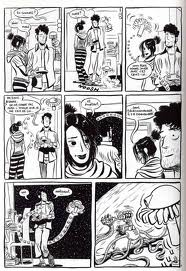
So what can we take away from those books? That the French are utterly, astonishingly, so much less fettered in their imagination that even when working on very familiar ground they inject freshness into the story. Sambre appears to be a love story between a young, depressed nobleman and a beautiful vampire. The middle third contains one long intercut seduction/sex scene in a crypt that is gorgeously drawn and staged. Orbital looks to have a future Earth being invaded by dark spider/insect aliens and the drama of the rag-tag interstellar who will have to learn to work together to save the planet.

Lupus? I have no idea what the fuck is going on. Other than it appears that Peeters doesn’t own a pencil and simply goes straight to ink on every panel that he draws. The wet, inky boldness of his drawing both sucks me in and makes the book appear to have simply appeared from his sketchbooks as opposed to the intricate work in Sambre and Orbital.

There is more design imagination in the construction of the Orbital architecture than in the last 12 issues of Fantastic Four and X-Men. And, yes, there are certainly echos of McKie, and Alien and Blade Runner and the Rebel Alliance but who cares? Even working the interstellar troops trope the books crackles with conviction

Next up: thoughts on how the page count and page size contributes to the storytelling experience (and differences therein). Not to mention the revelation that men have penises during sex scenes.

Sunday, January 06, 2008

In Review Of: Local #8 by Woods and Kelly

Been catching up on some of the comics that slipped a little under the radar, and I'm working my way through the issues of Local that my LCS has on hand. I know that I'm only getting part of the picture, but that is also part of the fun here as well.

Digression here: does anyone remember coming into a series in progress, in my case the 1970's Avengers and Defenders, and hearing the characters talk about past adventures and finding my imagination racing as I would think about those stories, stories that i haven't read and, back then, would likely never read since the back issue market was decidedly underdeveloped for 7 year olds. Invariably, when I did read them, much later in some cases, some of them were not nearly as good as I had imagined, but some were better than I had thought as well.

Brian Wood has his stories to consider, and here, after last issues digression into her family, we catch up with Megan working as a waitress, but more importantly, working on her relationships with men. Whether getting banged in the backroom of the restaurant, or in a rich man's apartment, she's learning that sex isn't actually the goal here. Love is. Its not a novel story, nor is it a novel ending, which makes it all that much harder to make the damn story work.

Wood and Kelly make the thing work because they're so damn sincere about it, and pull no punches when it comes to showing us Megan's search for love, sex and/or an interesting mixture of the two. Is this not what our 20's end up being? Sometimes a scary mix of relationships that we want to remember and bad decisions that we are more than happy to forget. Megan epitomizes just about everything that I can remember and wish to forget.

From getting screwed on a futon surrounded by empty beer bottles to every roommate that she's run out on, Megan is a mess, but she's a realistic mess. And in the final panels of the issue she makes choices, choices that are less about right and wrong and more about who she is. And isn't that what its all about?

I'd be remiss not to mention how much I enjoy the economy of story that Woods is using to give us single issue stories. Read the whole series and we get to see the macro story arc, but far more important is getting a great 22 page story in a single issue. Very few people are doing that, and it bears mentioning and supporting the beauty sometimes of that single short story. Well done.

Monday, September 03, 2007

If Its Always Someone's First Comic, Couldn't It Just As Easily Be Their Last?

There is a popular thought process that Jim Shooter was the perfect cheerleader for: the notion that the comic must be basic enough for anyone to read, after all, "Any comic could be someone's first comic." An attitude that has been championed by more than a few people in the business. Recently, however, I've had reason to rethink the old canard, and I wanted to put this out to you, blogdom assembled.

The notion that any particular comic could be someone's first issue, and thus would need not only a recap, but a degree of "dumbing down" on the storytelling side so that the visual language of the comic would not be an impedement to understanding this month's story. Unfortunately, over the last couple decades, what we've seen are a far greater number of comics that become the last issues rather than the first issues. comics have been losing numbers in droves, so making the point that we have to potentially sacrifice the complexity of story or storytelling so as not to drive away a potential new reader, may well be moving us in the wrong direction. We may have been actively pushing away the reader who is constantly looking for something to grow with them.

It does make sense, for instance, to keep the "every issue a first issue rule" when you look at the industry demographic/marketing plan through the 1940s to 1960s: your comics were targeted towards the same age range, so instead of moving upwards with a person's age, you had to hope to replace the same number of readers that "age out" with a similar number that grow into reading your books. Already there are flaws with the system, when you look at birth statistics during the baby boomer years. Without new product to go along with your new kids, you really have no hope of expanding your market.

And of course, this ties back to my In Search Of: The Elusive Bridge Comic" post that generated some interesting discussion, by trying to make the point that we come to different content within the same media over the years with different expectations. It would be interesting to say that "every movie is going to be someone's first movie", so we shouldn't do anything too advance in terms of flashing forward (The Shining) , flashing backward (Momento) or being too inventive with out camera angles (Seven) . There should be no room for ambiguity (Lost in Translation) lest we basically piss off the viewer so badly that they never return to view another movie again.

Hard to read that without laughing, isn't it?

So here's what we do: we don't continually tie the hands of creators. We have books that are not meant for the 6 year old, or the 12 year old, but for the adult. And we make sure that we have books at that 6 year old level that don't insult their intelligence. My almost 7 year old daughter is already telling me what the theme of a movie or book will be in the first third of the story. She understands subtext without knowing what that word means yet. We don't need to keep the material within the medium stupid.

Challenge me. Make me think. Keep me awake. Keep me buying. Or that next comic might be my last.

Friday, January 05, 2007

Storytelling Decisions: The moment or the moment before

Away from the scanner, so I'm not going to pepper this with any images, but the verbal will have to suffice.

So there are more than a few thoughts on the art of storytelling that I have as I work my way through the story of Pistoleras. And I recall an article by Jim Steranko many years ago, accompanied his pre-production painting from Raiders, where he made a point that while other artists preferred the moment of the balloon exploding, he prefered the moment just before the balloon exploded, the pregnant pause.

I've thought a lot about this over the years, and nowhere is it more interesting that trying to decide how to use a panel that shows a passage of time, perhaps during a conversation. I think that usually we see a panel isolate a moment in time, where Peter Parker expresses an opinion to Mary Jane, but there are other examples where, in a two shot, the Ben Grimm will ask Reed Richards not to do something, and Reed Richards will press the button opening the negative zone anyway. Fairly straight forward, but the image will be of Reed pressing the button. So we, as a reader, are asked to ignore the right side of the panel with Reed pressing the button and we need to read left to right and only pay attention to Ben gesticulating in the right side of the panel. Kirby was the master of making sure that we could read across properly to "get" the pacing of the story. Eisner was great about that as well, obviously.

So how much do you compress the story, and how much do you expand?. Bendis is considered the king of decompression in these modern times, a storytelling method that I tend to find almost a "tick" and stylistic choice, and one that I enjoy in Powers tremendously. The compression inherent in, say, the early Justice Leagues by Sekowsky and Fox, is so tight, that it almost offends my modern sensibilities. Hey, the original Starro attack on the JLA would at least have been worth two issues of the Avengers as layed out by Kirby and drawn by Heck.

I enjoy the decompression of the Manga that I get in Genshiken (my favorite manga of all time), but it would be foreign to me in, say, Spider Man or Fantastic Four. Pistoleras is as much a story of place to me as much as it is the story of the four girls and feminine empowerment. I want people to feel the heat of the desert of Mexico, and the crash of waves. I want them to get as much as they can in black and white and grey.

There are as many approaches to this as there are stories. Given a little more time and my scanner, I'll post some different examples. Any thoughts?